
High Frequency Series UPS: Efficiency, Technology and How to Choose
A high frequency series UPS (uninterruptible power supply) protects critical equipment from power outages, voltage sags, and electrical noise — using lightweight, high-efficiency converter technology that has made it the default choice for most modern IT and industrial installations. This guide explains how high frequency UPS technology works, where it shines, and how to size one correctly.
1. What Is a High Frequency Series UPS?
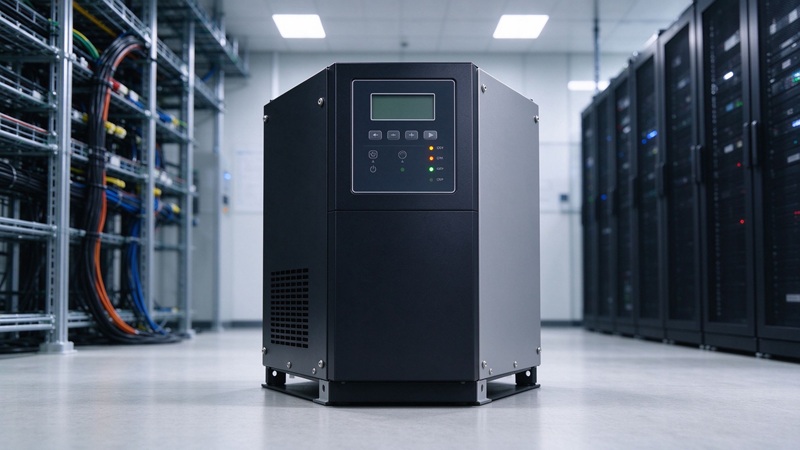
The term "high frequency" refers to the operating frequency of the power converter inside the UPS. A traditional (power frequency) UPS converts power at the mains line frequency of 50 or 60 Hz, using large, heavy transformers. A high frequency UPS instead converts power at tens of kilohertz using compact high-frequency PWM switching technology.
The result is a unit that is smaller, lighter, more efficient, and quieter than an equivalent power frequency machine — while still delivering clean, double-conversion sine wave output.
2. How High Frequency Technology Works
A high frequency online UPS follows a double-conversion topology:
Rectifier stage — incoming AC is converted to DC.
DC bus — powers the inverter and charges the battery bank.
Inverter stage — converts DC back to clean, regulated AC at 50/60 Hz.
Because the load is always powered by the inverter (never directly from mains), there is zero transfer time during a power outage — no flicker, no reboot, no data loss. The high switching frequency allows smaller magnetic components and transformers, which is why the units are so much lighter than older designs.
3. Key Benefits of the High Frequency Series
表格
| Benefit | Why It Matters |
|---|---|
| Higher efficiency | 95–96% under normal load — lower heat and electricity cost |
| Compact & lightweight | Small footprint, easy rack or floor installation |
| Zero transfer time | Online double-conversion — no power glitch during outages |
| Pure sine wave output | Safe for sensitive servers, PLCs, and medical equipment |
| Lower cost | Fewer materials and smaller footprint reduce purchase price |
| Quieter operation | High frequency design runs cooler and quieter |
4. Typical Applications
Server rooms and data centers — protecting racks of servers and network gear
Banks and financial institutions — keeping ATMs and trading systems online
Hospitals and clinics — backing up medical devices and record systems
Office buildings — protecting critical workstations and VoIP systems
Industrial control systems — PLCs, HMIs, and instrumentation
5. High Frequency vs. Power Frequency UPS: Which Do You Need?
Choose High Frequency Series if:
Your load is under a few hundred kVA and space is tight
You want higher efficiency and lower operating cost
The environment is clean (office, server room, control room)
Choose Power Frequency Machine UPS if:
You have a heavy industrial or outdoor environment
You need robust overload tolerance for motor starts
Power reliability and isolation from harsh conditions matter more than footprint
6. Sizing Guidelines
Total the wattage of all connected equipment.
Add 20–30% headroom so the UPS runs at 50–70% load.
Decide the required battery runtime (match to generator startup, usually 10–30 min).
For longer runtime, choose a model that supports external battery cabinets.
Example: 8 servers at 500W each = 4000W → add 25% → select a 6kVA / 4.8kW high frequency UPS.
7. Get a Quote
Whether you need to protect a server room, an office, or a control system, the high frequency series UPS delivers the efficiency, compactness, and seamless protection that modern operations demand. Contact our engineering team for model selection, runtime calculations, and volume pricing.