
High Frequency Rack Mounted UPS: Ideal Power Protection for Server Rooms and Data Centers
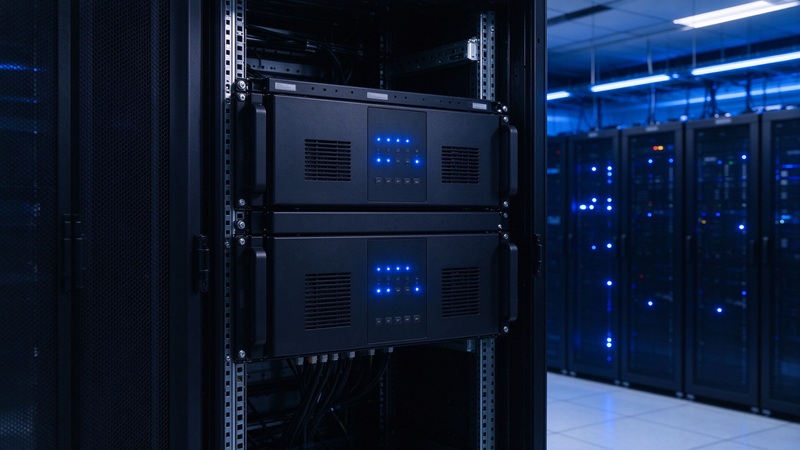
In a server room, even a 100-millisecond power glitch can crash services, corrupt databases, or trigger costly downtime. A high frequency rack mounted UPS (uninterruptible power supply) is the frontline defense — delivering clean, conditioned AC power and seamless battery backup in a compact 19-inch rack chassis.
This guide covers what high frequency rack mounted UPS systems are, why they dominate modern server rooms, and how to choose the right model.
1. What Is a High Frequency Rack Mounted UPS?
A UPS sits between the utility power feed and your IT equipment, performing three jobs:
Conditioning — filters voltage spikes, sags, and electrical noise
Battery backup — instantly switches to battery when mains power fails
Frequency and voltage regulation — keeps output within tight tolerances
A high frequency UPS uses modern high-frequency PWM technology, operating the power converter at tens of kilohertz instead of the traditional 50/60 Hz line frequency. This yields a smaller, lighter, and more efficient unit. A rack mounted UPS fits into a standard 19-inch equipment rack, typically 2U to 6U tall.
2. Why High Frequency Rack Mounted UPS Is the Standard for IT
Smaller Footprint, Lower WeightHigh frequency technology shrinks the transformer and heat sink size. A 3kVA high frequency rack UPS may weigh half as much as an equivalent older tower unit — critical for rack environments where space matters.
Higher EfficiencyOnline double-conversion high frequency UPS units typically achieve 95–96% efficiency under normal load, reducing heat output, air-conditioning load, and operating costs.
Pure Sine Wave OutputServers, storage arrays, and network switches require clean, stable sine wave power. A high frequency rack UPS delivers THD < 3%, protecting sensitive power supplies inside IT equipment.
Online Double-Conversion TopologyIn online double-conversion mode, the load is ALWAYS powered through the inverter — the mains feed only recharges the battery. This means zero transfer time during a power outage: no glitch, no reboot, no dropped connection.
Rack-Optimized Design19-inch standard chassis, front-access battery replacement, LCD display on the front panel, and SNMP / USB / RS232 communication for remote monitoring.
3. Key Specifications to Compare
Rated power (VA / W) — must cover your total IT load with headroom
Efficiency at 50% load — biggest impact on long-term electricity cost
Battery runtime — match to your backup generator startup time (typically 10–30 min)
Transfer time — online double-conversion = 0 ms
THD (output) — <3% for IT-grade protection
Communication ports — SNMP card for remote monitoring and auto-shutdown
Noise level — <45 dBA for office-adjacent server rooms
4. Typical Applications
Small and Medium Data Centers — rack-mounted UPS units distributed across server racks
Server Rooms and IT Closets — file servers, routers, VoIP phone systems
Network and Telecom Cabinets — edge network nodes, roadside telecom cabinets, PoE switches
Industrial Control Rooms — PLC systems, HMIs, industrial PCs surviving voltage sags
5. Sizing Guidelines
Total the wattage of all equipment that must stay online.
Add 20–30% headroom — a UPS running at 50–70% load is most efficient.
Calculate required runtime — list critical loads and decide how long the UPS must sustain them.
Account for battery expansion — choose a model that supports external battery packs if you need longer runtime.
Example: 5 servers at 400W each = 2000W. Add 25% headroom → select a 3kVA / 2.4kW UPS.
6. Get a Quote
Whether you are outfitting a new server room, upgrading an aging UPS, or deploying remote edge sites, the high frequency rack mounted UPS class delivers the efficiency, compactness, and zero-glitch protection that modern IT infrastructure demands. Contact our team for model selection, runtime calculations, and volume pricing.