
Power Frequency Machine UPS: Heavy-Duty Industrial Power Protection
When the environment is harsh and the loads are heavy, a standard high frequency UPS may not be enough. The power frequency machine UPS is built for exactly these conditions — using traditional 50/60 Hz transformer technology to deliver rugged, isolated, double-conversion power that can survive industrial heat, dust, motor surges, and long duty cycles. This guide explains what sets the power frequency machine UPS apart and where it is the right choice.
1. What Is a Power Frequency Machine UPS?
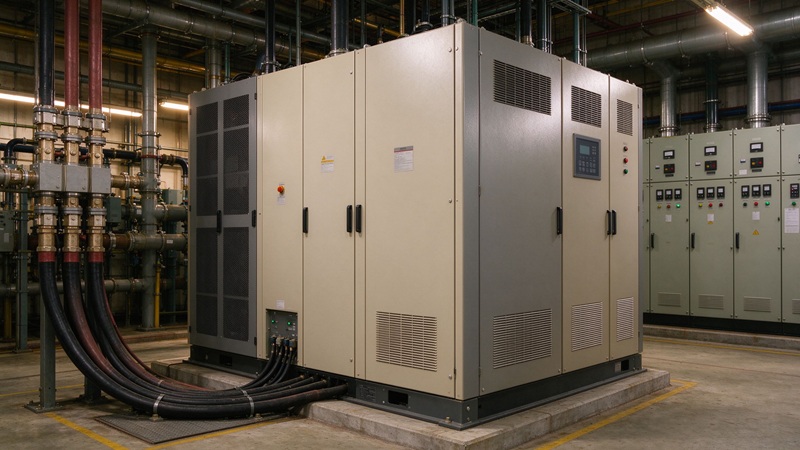
A power frequency machine UPS converts power at the line frequency (50/60 Hz) using a heavy isolation transformer. This design has been the backbone of industrial-grade power protection for decades. Compared to high frequency UPS, the power frequency machine UPS is larger and heavier, but it offers superior overload capacity, galvanic isolation, and tolerance for demanding electrical environments.
2. Key Technical Advantages
Galvanic IsolationThe built-in isolation transformer separates input and output electrically. This blocks harmonics, surges, and common-mode noise from passing between the mains and your critical load — essential in industrial sites where nearby motors, welders, and drives pollute the supply.
High Overload and Short-Circuit CapacityPower frequency machines can typically handle 150% overload for 60 seconds and 200% for 10 seconds — enough headroom to start heavy motors and inductive loads without tripping.
Robust Design for Harsh EnvironmentsWith heavy enclosures, wide operating temperature ranges, and higher ingress protection, power frequency UPS units are built to keep running in plant floors, substations, and outdoor cabinets where a high frequency unit would overheat.
Long Service LifeTransformer-based design and conservative component derating give power frequency machines a longer operational lifespan, often exceeding 10–15 years with routine maintenance.
3. Key Specifications
表格
| Specification | Typical Value |
|---|---|
| Power range | 10 kVA – 800 kVA+ |
| Topology | Online double-conversion |
| Isolation transformer | Input / output isolation |
| Overload capacity | 150% for 60s, 200% for 10s |
| Efficiency | 90–94% |
| Input power factor | 0.99 (with active PFC rectifier) |
| Noise level | 55–65 dBA |
4. Typical Applications
Heavy industrial plants — conveyors, compressors, and production lines
Petrochemical and oil & gas — remote facilities with unstable grid supply
Hospitals and critical infrastructure — operating rooms, imaging equipment, emergency systems
Telecom exchanges and data centers — high-availability centralized UPS rooms
Marine and offshore — shipboard and rig power protection
5. Power Frequency vs. High Frequency: Quick Decision
表格
| Factor | Power Frequency | High Frequency |
|---|---|---|
| Footprint | Large, heavy | Compact, light |
| Efficiency | 90–94% | 95–96% |
| Overload capacity | Very high | Moderate |
| Isolation | Built-in transformer | Optional |
| Best environment | Industrial, harsh | Office, clean IT |
| Initial cost | Higher | Lower |
Choose Power Frequency Machine UPS if: you face motor-heavy loads, harsh environmental conditions, or need maximum robustness and galvanic isolation.
Choose High Frequency UPS if: efficiency, footprint, and operating cost are your priorities in a clean environment.
6. Sizing Guidelines
Account for motor starting currents — size to cover the largest motor's inrush plus running loads.
Apply the same 20–30% headroom rule for normal running load.
Consider external battery cabinets for extended runtime.
Plan for proper ventilation and clearance around the heavy unit.
7. Get a Quote
For heavy industrial loads, harsh environments, and mission-critical operations, the power frequency machine UPS offers the ruggedness and reliability that smaller units cannot match. Contact our engineering team for sizing assistance, model selection, and pricing for your application.